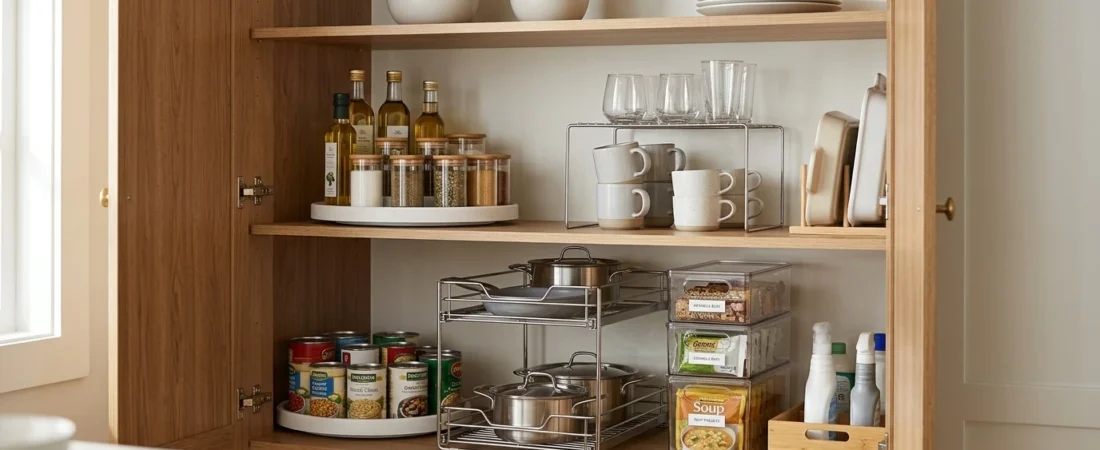
If you’ve ever lost a can of soup to the back of a deep cabinet, you already know the struggle. Learning how to organize kitchen cabinets with deep shelves is one of those game-changers that makes your whole kitchen feel calmer and more functional. In this guide, you’ll learn a simple step-by-step system, the best affordable tools to make it stick, and how to keep it looking great long-term even on the busiest weeknights.
😤 Why Deep Kitchen Cabinets Are So Hard to Keep Organized
You’re not doing it wrong. Deep cabinets are genuinely tricky by design. There are a few root causes that trip up almost everyone:
- Things get buried. Items at the front block access to the back, so stuff just disappears.
- No natural stopping point. Shallow cabinets force you to stack carefully. Deep ones invite chaos.
- Out of sight, out of mind. If you can’t see it, you forget it exists and buy duplicates.
The result? A disorganized cabinet that wastes food, wastes money, and wastes your time. The good news is that deep cabinet organization isn’t about being tidy by nature. It’s about using the right systems.
📋 Step-by-Step: How to Organize Kitchen Cabinets with Deep Shelves
🧹 Step 1: Empty Everything Out and Declutter First
Before you organize, you need a blank slate. Pull everything out — yes, everything — and sort it into three piles: keep, donate, and toss.
Pro tip: Check expiration dates while you’re at it. You’ll likely free up more space than you expected.
- Toss anything expired or broken
- Donate duplicates you genuinely won’t use
- Keep only what you actually reach for
Starting fresh makes every other step faster and easier.
🗺️ Step 2: Create Zones Based on How You Actually Cook
Don’t just put things back randomly. Group items by how you use them — baking supplies together, canned goods together, snacks together.
Think about your real cooking habits, not an ideal version of yourself. If you make pasta three times a week, that cabinet should be front and center. Assign each zone to a specific cabinet based on proximity to where you use it (near the stove, near the pantry, near the fridge).
This simple habit cuts down the time you spend hunting for things by a surprising amount.
🔄 Step 3: Use a Lazy Susan for Instant Accessibility
A turntable lazy susan is one of the best storage solutions for deep cabinets, full stop. Place one in the corner of a deep shelf and suddenly everything rotates into reach with a single spin.
- Use a two-tier lazy susan for spices or small jars
- Use a large single-tier one for bulkier items like oils and vinegars
- Choose a style with raised edges so things don’t slide off
You can find a solid lazy susan for $10–$20, and it will immediately transform how you use that space.
🚪 Step 4: Add Pull-Out Shelf Organizers for Lower Cabinets
Lower deep cabinets are the worst offenders for lost items. Pull-out shelf organizers (also called sliding cabinet organizers) let you glide the whole shelf toward you like a drawer.
No more crouching and reaching into the dark. Look for:
- Two-tier sliding organizers for pots, pans, or canned goods
- Options with soft-close mechanisms for longevity
- Ones that install without drilling if you’re renting
These typically run $25–$50 and are worth every penny for kitchen shelving sanity.
📏 Step 5: Use Risers to Double Your Vertical Space
Most deep cabinets have more vertical room than you’re using. Shelf risers sit on top of your existing shelf and create a second level, letting you store twice as much without adding a single cabinet.
Stack plates on the bottom, bowls on the riser. Or store mugs below and glasses above. Risers are especially helpful for:
- Baking dishes and cutting boards stored upright
- Canned goods in a two-row stadium arrangement
- Matching sets of dishes you use at different frequencies
A set of two risers usually costs under $15.
💰 Best Budget Products for Organizing Deep Kitchen Cabinets
You don’t need to spend a fortune. Here are six tried-and-true picks:
- Turntable Lazy Susan — $10–$20 (great for spices and condiments)
- Two-Tier Sliding Cabinet Organizer — $25–$45 (transforms lower cabinets)
- Adjustable Shelf Risers — $12–$18 for a set of two
- Clear Stackable Storage Bins — $15–$25 for a set (great for snacks and packets)
- Pull-Out Drawer Organizer with Handles — $30–$50 (easy access without bending)
- Bamboo Drawer Dividers — $10–$15 (ideal for utensils and small items)
Most of these are available at Target, Amazon, or IKEA. You don’t need all six — pick the one or two that solve your biggest pain point first.
⚠️ Common Mistakes to Avoid When Organizing Deep Shelves
- Putting the most-used items in the back. Fix: Always store everyday items at the front within arm’s reach.
- Skipping the declutter step. Fix: Organizing clutter just makes it neater clutter — always purge first.
- Buying organizers before measuring. Fix: Measure cabinet depth, width, and height before you shop.
- Mixing unrelated items in one zone. Fix: Keep like with like; random groupings break down fast under daily use.
🔁 How to Keep Your Deep Cabinets Organized Long-Term
Good pantry organization doesn’t maintain itself, but it doesn’t take much to keep it going either. Try these four habits:
- Do a 2-minute reset once a week. Put stray items back where they belong before the chaos builds.
- Use the “one in, one out” rule. When you buy something new, check if something old needs to go.
- Label your zones. A simple label on the shelf edge reminds everyone (including you) where things live.
- Restock from the back. When adding new cans or jars, push older ones forward so nothing expires unnoticed.
None of these take more than a few minutes. Done consistently, they make a big difference.
🎉 Final Thoughts + Call to Action
Deep cabinets don’t have to be a black hole. Here are the three things to remember:
- Start with a full declutter — you can’t organize your way around too much stuff.
- Use the right tools — a lazy susan and pull-out organizers do most of the heavy lifting.
- Build simple habits — a two-minute weekly reset keeps everything from unraveling.
You don’t need to tackle this all in one afternoon. Pick one cabinet today, apply just the first two steps, and see how it feels. Sometimes that single win is all the motivation you need to keep going.