🧺 The Ultimate Pantry Organization System for Small Spaces
Your pantry is small. You keep reorganizing it, and somehow it still looks like a grocery store exploded in there. Small pantry organization ideas that actually work aren’t about buying more stuff they’re about using the space you already have smarter. In this guide, you’ll get a complete step-by-step system to transform even the tiniest pantry into something functional, easy to maintain, and genuinely pleasant to open.
😤 Why Small Pantry Organization Is Harder Than It Looks (And How to Fix It)
You’d think a smaller space would be easier to manage. It’s not. The problem is that small pantries punish disorganization faster and harder than large ones. Three root causes show up again and again:
- No clear zones. Everything gets thrown in together, so finding anything means hunting through everything.
- Vertical space is ignored. Most people use only the first 12 inches of every shelf, leaving a ton of usable height completely wasted.
- Products are too deep on the shelf. Items disappear behind each other, and you forget they exist until they expire.
The fix isn’t more storage bins. It’s a real system applied once, maintained in minutes.
📋 Step-by-Step: Small Pantry Organization Ideas That Actually Work
🧹 Step 1: Empty Everything Out and Start From Zero
Don’t skip this. Pull everything out of your pantry completely yes, every single item. Lay it all on your kitchen counter or table.
💡 Pro tip: Check every expiration date while you’re at it. Most people throw away 20–30% of what’s in their pantry during this step alone.
- Toss anything expired or stale
- Donate unopened items you genuinely won’t use
- Group what’s left into loose categories before putting anything back
Starting fresh is the only way to build the right system.
🗺️ Step 2: Assign Zones Before You Put Anything Back
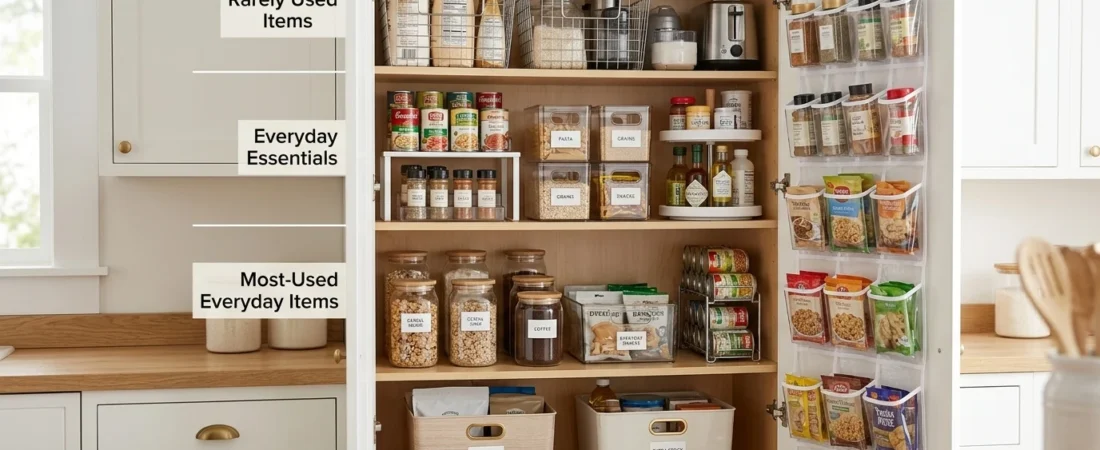
Zoning is the single most important step in any pantry organization system. Decide in advance where each category lives, and stick to it.
A simple small pantry zone setup that works:
- Eye level → most-used everyday items (oils, pasta, canned tomatoes)
- Top shelf → rarely used items (extra stock, special occasion ingredients)
- Bottom shelf → heavy items (bags of flour, rice, water bottles)
- Door or side → spices, small packets, snacks
Write your zones down before you start loading the shelves. It takes 5 minutes and saves hours of frustration later.
🔄 Step 3: Use Shelf Risers to Double Your Vertical Space
Most pantry shelves have 12–18 inches of vertical clearance and most people use about half of it. Shelf risers create a second level on any existing shelf, letting you store twice as much in the same footprint.
- Stack canned goods in a stadium arrangement so you can see every label
- Use a riser for spice jars so nothing hides behind anything else
- Double your coffee and tea station with a small two-tier riser
A set of two adjustable risers costs around $12–$15 and is one of the highest-ROI pantry purchases you can make.
🧲 Step 4: Add Clear Bins to Corral Loose Items
Loose bags of chips, random packets, half-used boxes these are the enemy of a tidy pantry. Clear stackable bins give every loose category a home.
Pull the bin out, grab what you need, slide it back. Done. Look for bins that:
- Are clear (so you can see contents without pulling them out)
- Have open fronts or handles for easy grabbing
- Stack securely so you can use vertical space
Label each bin with a simple sticky label or a label maker. Even messy households can keep this system going because there’s always an obvious place to put things back.
📐 Step 5: Use the Door — It’s Free Storage
If your pantry has a door, you have an untapped storage wall. Over-the-door organizers can hold spices, snacks, foil, wrap, cleaning supplies, and more without taking up any shelf space.
- A 24-pocket over-door organizer holds an entire spice collection
- A simple hooks-and-bins system on the door works for snacks and kids’ items
- Slim magazine holders attached to the door store cutting boards or baking sheets upright
Over-door organizers start at $15–$25 and install in under 10 minutes with no tools.
💰 Best Budget Products for Small Pantry Organization Ideas
You don’t need to spend hundreds. These six picks do the heavy lifting:
- Adjustable Shelf Risers — $12–$18 (doubles your usable shelf space instantly)
- Clear Stackable Bins with Open Fronts — $20–$30 for a set of 6
- Over-the-Door 24-Pocket Organizer — $18–$25 (great for spices and snacks)
- Lazy Susan Turntable — $10–$18 (perfect for a corner or hard-to-reach shelf)
- Label Maker or Chalk Labels — $10–$20 (makes the system stick long-term)
- Can Rack Organizer — $12–$20 (auto-rotates canned goods, first in first out)
Most are available at Target, Amazon, or IKEA. Start with just one or two that solve your biggest pain point — you don’t need to buy everything at once.
⚠️ Common Mistakes to Avoid
- Organizing without decluttering first. Fix: Always purge before you organize neat clutter is still clutter.
- Buying bins before measuring. Fix: Measure shelf depth, width, and height before you order anything online.
- Mixing unrelated categories in one bin. Fix: One bin, one category even if the bin isn’t completely full.
- Ignoring the door and vertical space. Fix: Treat every inch including the door and the air above your cans as usable storage.
🔁 How to Stay Consistent Long-Term
The system only works if it’s easy enough to maintain on a tired Tuesday night. These four habits take under 5 minutes each:
- 5-minute Sunday reset. Before your weekly grocery run, spend 5 minutes putting stray items back where they belong.
- Restock from the back. When adding new groceries, push older items forward so nothing expires unnoticed.
- One-in, one-out rule. When you buy a new pantry item, check if an old one needs to go.
- Monthly 2-minute scan. Once a month, quickly check your bins. If a category is overflowing its bin, it’s time to declutter again.
🎉 Final Thoughts + Call to Action
A small pantry isn’t a limitation it’s just a space that needs a smarter system. Here are the three things to take away today:
- Start with a full empty-and-declutter you can’t organize around clutter, no matter how many bins you buy.
- Zones and labels do most of the work once everything has a home, maintaining the system becomes automatic.
- Use every inch of vertical space and your door that’s where small pantries hide their secret capacity.
You don’t need a weekend and a $200 budget to make this happen. Pick one shelf today, apply steps 1 and 2, and see how it feels. Ready to go further? Check out our guide on 🗄️ How to Organize Kitchen Cabinets with Deep Shelves for even more kitchen storage solutions.