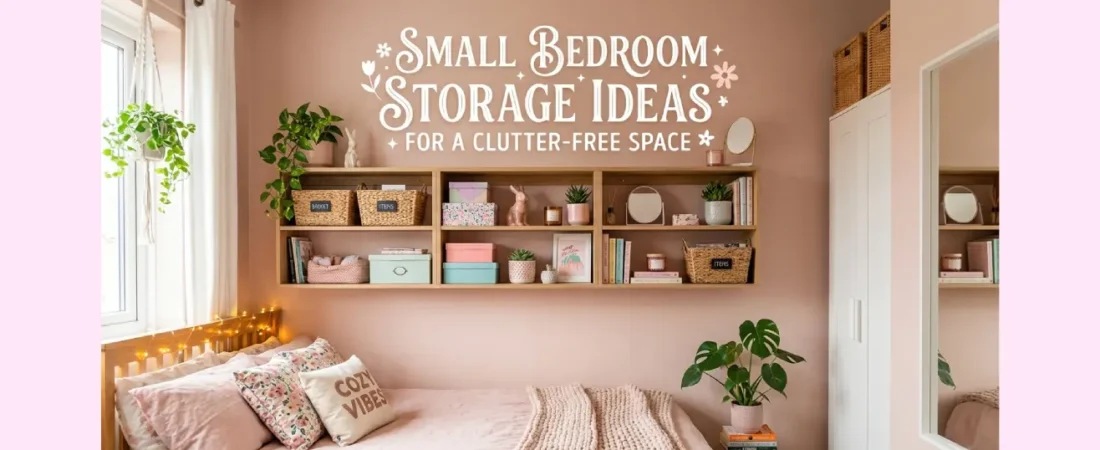
A small bedroom doesn’t have to feel cramped. But if yours is overflowing with clothes you can’t close, a nightstand buried under stuff, and no idea where anything actually lives that’s not a space problem. That’s a storage strategy problem. The secret to small bedroom storage isn’t more bins it’s maximizing vertical space, utilizing the 40 square feet under your bed, and applying the Zone Method to prevent clutter from returning. In this guide, I’ll walk you through the exact approach I used to transform a 120-square-foot bedroom into something that finally felt calm, organized, and mine.
📐 The Real Reason Small Bedrooms Feel Impossible to Organize
Before we talk solutions, let’s talk about why the problem keeps coming back even after you’ve already tried to fix it.
Most people approach a small bedroom the same wrong way: they buy storage furniture, shove things in, and call it done. Three weeks later, it’s chaos again.
Here’s what’s actually happening:
- Vertical space goes completely unused. The average bedroom has 8 feet of ceiling height but most storage only goes up 4 feet. That’s half your storage potential sitting empty above your head
- The floor becomes the default. When nothing has a designated home, the floor fills up fast and a cluttered floor creates visual weight that makes any room feel half its actual size
- Furniture choices fight the room. A bulky dresser doesn’t solve storage it is the storage problem, eating up floor space while holding things you barely wear
I lived with a small bedroom for three years before I realized my dresser a solid oak 50-inch wide, six-drawer piece was the enemy. It occupied 14 square feet of floor space and held mostly clothes I wore once a season. The spatial footprint alone was costing me more than I realized. Removing it and replacing it with a smarter under-bed and closet system changed everything and gave my room back nearly a third of its usable floor space.
🔍 According to a 2022 survey by the National Association of Home Builders, the average new American bedroom has shrunk by nearly 15% over the last two decades yet the amount of stuff people own has increased. The gap between space and stuff is the root of the problem.
Pro tip: Before buying anything new, measure your room and sketch a simple floor plan. Knowing your exact square footage changes every decision that follows.
⚠️ The “Hidden” Clutter Trap: Check the top of your wardrobe right now. If it’s covered in loose items, it’s creating visual noise that makes your room feel smaller. Fix: use two or three uniform lidded boxes to turn that chaotic surface into a clean architectural line.
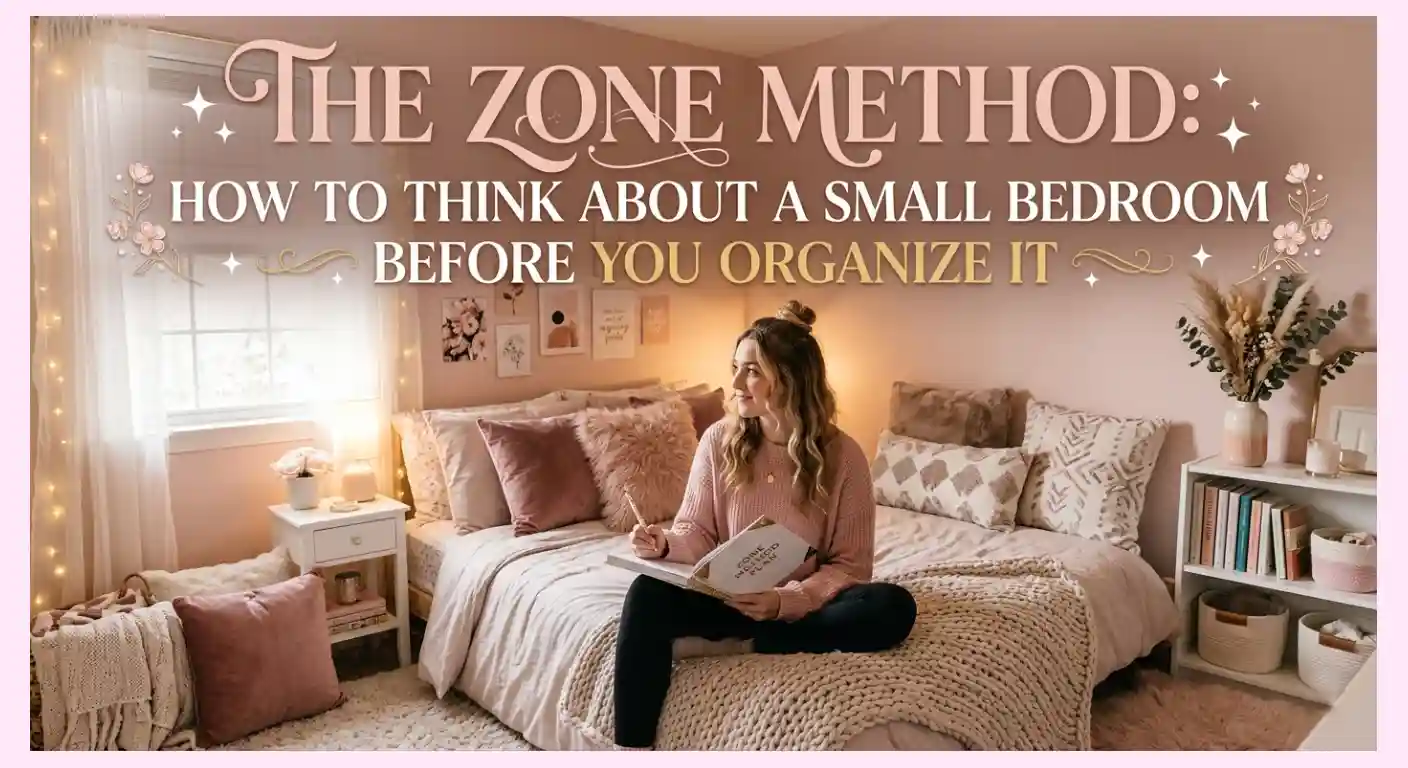
🗂️ The Zone Method: How to Think About a Small Bedroom Before You Organize It
Most bedroom organization guides jump straight to product recommendations. I want to do something different first because the Zone Method is what actually makes the difference between a system that lasts and one that falls apart in a month.
Divide your bedroom into four functional zones:
- Sleep zone: Just your bed and immediate nightstand nothing else competes for this space
- Clothing zone: Closet, under-bed storage, and any clothing-specific furniture
- Work or hobby zone: Desk, reading chair, or any activity you do beyond sleeping
- Transition zone: The area near the door where things land when you walk in
Once you identify your zones, the rule is simple: every item in your bedroom belongs to exactly one zone. If something doesn’t fit any zone, it doesn’t belong in the bedroom at all.
I had three candles, two books, a charging cable, a hair tie collection, a half-finished puzzle, and a resistance band all competing for space on my single nightstand. None of those things belonged to the same zone. Sorting them — and finding each a proper home within its zone cleared the surface entirely without buying a single organizer.
🔍 Research from Princeton Neuroscience Institute shows that visual clutter directly competes for cognitive attention, even when you’re not actively looking at it. A cluttered bedroom measurably affects sleep quality and morning mood both of which impact your entire day.
🏃 The 10-Minute Win: Pick one Zone from the list above right now, before reading further. Remove exactly three items that don’t belong there. Put them where they actually go. Come back and finish reading. That small action will make the rest of this guide feel immediately real, not theoretical.
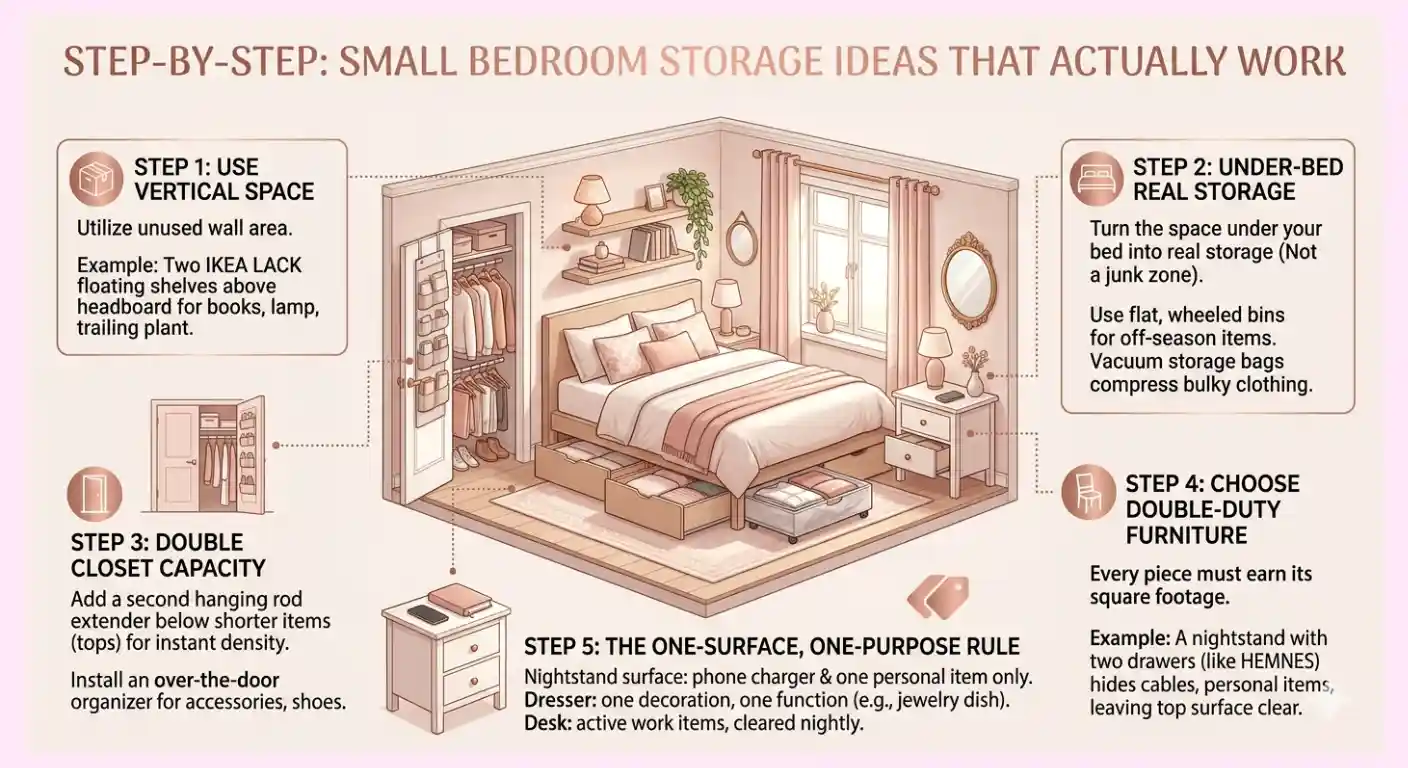
🪜 Step-by-Step: Small Bedroom Storage Ideas That Actually Work
📦 Step 1: How to Use Vertical Space When You Have Zero Floor Room
The fastest way to add storage in a small bedroom is to stop thinking horizontally and start thinking vertically. Walls are free real estate that most people never touch and in a square footage optimization mindset, every inch of wall above waist height is a storage opportunity.
Here’s what works:
- Floating shelves above the bed: A pair of shelves mounted 6–8 inches above your headboard adds display and storage without touching the floor
- Tall, narrow bookcases: A 72-inch bookcase takes the same floor footprint as a small nightstand but holds five times more with minimal visual weight if you choose an open, airy design
- Tension rods inside closets: These aren’t just for curtains a tension rod mounted horizontally inside a closet creates an instant second hanging rail with zero drilling
- Pegboards or wall hooks: Perfect for bags, jewelry, hats, or anything you grab daily they add storage density without furniture
Concrete example: I installed two IKEA LACK floating shelves (15¾ × 10¼ inches each) above my bed for $19 each. They now hold my books, a small lamp, and a trailing plant. My nightstand which previously held all of those things now has only a glass of water and my phone. That single change made my bedroom feel noticeably larger and introduced a minimalist aesthetic I’d been chasing for months.
Pro tip: When mounting shelves, go higher than feels natural. Most people mount too low. Aim for at least 18 inches above head height when lying down so shelves don’t crowd your sleep zone visually.
🛏️ Step 2: How to Turn the Space Under Your Bed Into Real Storage (Not a Junk Zone)
The space under your bed is one of the most underused areas in any home. In a small bedroom with a decluttering mindset, it’s not optional — it’s essential.
- Use flat, wheeled storage bins (look for ones under 7 inches tall) for off-season clothing, extra bedding, or shoes
- A bed with built-in drawers eliminates the need for a separate dresser entirely the most impactful single furniture swap for small rooms
- Vacuum storage bags compress bulky items like winter sweaters or extra pillows to a fraction of their size I fit an entire winter wardrobe into two bags the size of a carry-on
🔍 A standard queen bed frame sits approximately 13 inches off the ground enough space for storage containers up to 12 inches tall. That represents roughly 40 square feet of usable storage that most people leave completely empty.
I switched to a platform bed with two built-in drawers on each side a Zinus 14-inch SmartBase with under-bed drawers (roughly $280 total). Between those four drawers, I store every piece of clothing I own that isn’t hanging: sweaters, jeans, gym clothes, pajamas. The 50-inch oak dresser I donated freed up enough floor space to add a small reading chair. That one furniture swap genuinely transformed the feel of my entire room.
⚠️ Before you buy under-bed bins: Measure your bed frame clearance from the floor not the mattress, the frame. Many people buy bins that are 2 inches too tall. Take 30 seconds with a tape measure before clicking “add to cart.”
🚪 Step 3: How to Double Your Closet Capacity Without Buying New Furniture
Most people blame their bedroom for not having enough storage. The real culprit is usually a closet that’s operating at 50% of its actual capacity.
Before buying any bedroom furniture at all, audit your closet for storage density:
- Add a second hanging rod below shorter items (jackets, tops) to instantly double hanging capacity a tension-rod style extender costs $12 and takes 60 seconds to install
- Use shelf dividers to prevent folded stacks from toppling into each other
- Install an over-the-door organizer on the inside of the closet door for shoes, accessories, or small items 24 pockets, zero floor space
- Store seasonal items in labeled bins on the top shelf rotating twice a year keeps daily-use space reserved for what you actually reach for
Concrete example: I added a hanging rod extender to my 42-inch closet rod. My short tops now hang on the lower rod, longer items on the upper. That one change created space for fourteen additional hanging items no drilling, no tools, no professional help. Twelve dollars. Fourteen garments. Done.
🪑 Step 4: How to Choose Bedroom Furniture That Earns Its Square Footage
In a small bedroom, every piece of furniture must justify its floor footprint by serving at least two purposes. If it only does one thing, it’s probably stealing space that a smarter piece could use twice as well.
Smart double-duty picks:
- Ottoman with storage: Sits at the foot of the bed, stores extra blankets, acts as a seat three functions, one footprint
- Nightstand with two drawers: Beats a simple surface every time drawers hide charging cables, books, and skincare while the top stays clear
- Mirror with hidden storage: A wall-mounted jewelry mirror looks sleek and conceals a full organizer behind the glass storage density without visible clutter
- Desk with built-in vertical shelving: Combines workspace and storage without doubling the footprint crucial if you work from your bedroom
I replaced my flat-surface nightstand with one that had two drawers (a simple HEMNES from IKEA, 18½ × 13¾ inches). Suddenly everything that used to pile on top chapstick, hair ties, a book, my journal, my glasses disappeared inside. The surface stayed clear. The minimalist aesthetic I wanted finally had a chance to breathe.
🏷️ Step 5: How to Apply the “One Surface, One Purpose” Rule So It Actually Sticks
This is the maintenance rule that keeps everything from reverting to chaos and it’s the one most organization guides skip because it sounds too simple to matter. It isn’t.
Every flat surface in your bedroom gets exactly one purpose. Nothing else lives there:
- Nightstand surface: phone charger and one personal item only
- Dresser top (if you kept one): one decorative item, one functional item a jewelry dish counts, a pile of mail doesn’t
- Desk surface: active work items only, cleared at the end of every day
- Floor: zero items, zero exceptions the floor is not a storage zone
Honest caveat: Real life means things land on surfaces constantly. The goal isn’t perfection it’s a 60-second nightly reset that returns every surface to its single purpose before you sleep. Miss a night? Fine. Miss a week? The system collapses. One minute per night is the price of a calm bedroom.
🔍 A study published in the journal Personality and Social Psychology Bulletin found that people who described their homes as cluttered had measurably higher cortisol levels throughout the day with the strongest effect in the bedroom, where visual input is processed right before sleep and immediately upon waking.
🛒 Best Products for Small Bedroom Storage (All Under $40)
You don’t need to renovate. These six picks do the heavy lifting without breaking your budget:
| Product | Why It Works | Approx. Price |
|---|---|---|
| SONGMICS Under-Bed Storage Bins (set of 2) |
Wheeled, clear-lid, 5.9 inches tall fits most frames |
~$32 |
| SpaceAid Closet Hanging Rod Extender |
Doubles hanging capacity instantly, zero drilling |
~$12 |
| Simple Houseware Over-Door Organizer (24 pockets) |
Works inside closet or on bedroom door |
~$18 |
| VASAGLE Floating Wall Shelves (set of 2) |
Holds 22 lbs each, minimal hardware, clean minimalist look |
~$35 |
| Vacuum Storage Bags (8-pack) |
Compresses bulky seasonal items by up to 80% |
~$28 |
| Bamboo Bedside Caddy (hangs on headboard) |
Holds phone, book, glasses frees the entire nightstand surface |
~$16 |
Pro tip: Start with the under-bed bins and the closet rod extender. Together they cost under $45 and create more immediate visual impact than anything else on this list combined.
❌ Common Mistakes to Avoid
- Buying storage before decluttering. Organized clutter is still clutter fix: remove at least 20% of bedroom items before buying a single bin or shelf.
- Ignoring the back of doors. The inside of every door is usable storage fix: an over-door organizer on your bedroom or closet door adds 20+ pockets without touching a single wall.
- Keeping everything at floor level. Most bedroom storage stays below waist height, leaving 4+ feet of vertical space wasted fix: add one set of floating shelves this week and see how much lighter the room feels.
- Storing non-bedroom items in the bedroom. Kitchen gadgets, office supplies, and hobby equipment creep in slowly fix: once a month, do a “does this belong here?” sweep and relocate anything that doesn’t fit a bedroom zone.
📅 How to Keep a Small Bedroom Clutter-Free Long-Term
The hardest part isn’t the initial organization it’s the maintenance. These four habits each take under five minutes and are the difference between a system that lasts and one that collapses by month two.
60-second nightly reset. Before bed, return every out-of-place item to its zone. One minute. Every night. This single habit is worth more than any organizer you’ll ever buy.
The one-in, one-out rule with teeth. Every time a new piece of clothing enters your closet, one leaves. Not “eventually.” That same day. Here’s how I make this concrete: when I get home with something new, I hold it next to two items I wear the least and donate whichever I’m least excited about. The new item goes in, one goes into a donation bag by the door. The bag goes out when it hits five items usually within two weeks. Without this rule, a small bedroom closet reaches maximum capacity within six months of any reorganization. With it, the system self-regulates indefinitely.
Monthly surface audit. On the first of every month, stand at your bedroom door and look at every flat surface. Anything “temporarily” sitting somewhere for 30+ days has found a permanent home and it’s the wrong one. Relocate it or donate it.
Seasonal clothing rotation. Twice a year March and October work well move out-of-season clothing to under-bed storage. This keeps your daily-use closet space reserved for what you actually reach for right now, and makes getting dressed faster every single morning.
🎉 Final Thoughts + Call to Action
Here’s what matters most:
- Vertical space is your biggest untapped resource walls, doors, and the space above furniture can double your storage without touching your floor plan or your budget
- The Zone Method creates lasting organization when every item has a zone and every surface has a single purpose, the system maintains itself with minimal daily effort
- Double-duty furniture is non-negotiable in small spaces every piece that only does one job is occupying square footage that a smarter choice could use twice as effectively
Start with just one thing today. Go look under your bed right now. If it’s empty, you have 40 square feet of storage waiting. If it’s a graveyard of forgotten items and dust, you have your first weekend project and this guide has everything you need to tackle it with a real system instead of wishful thinking.
Ready to bring this same energy to the rest of your home? Check out our guide on How to Organize a Refrigerator to Reduce Food Waste the same zone-based approach applied to one of the most chaotic spots in any kitchen.
Your turn: Which of the four zones is the biggest problem area in your bedroom right now