Let me be honest with you: I used to dread walking into my own bedroom.
Not because it was dirty. Not because it was falling apart. But because every surface was covered in something clothes that didn’t make it back to the closet, books I swore I’d read, random objects that “belonged” there because they had nowhere else to go. My bedroom had become a dumping ground dressed up as a living space.
I finally hit a wall one Sunday afternoon. I sat on my bed, looked around, and decided: this weekend, it stops. I’m not moving until this room makes sense again.
That decision changed how I sleep, how I start my mornings, and honestly, how I feel at home. And in this guide, I’m going to walk you through the exact process I used to how to declutter a bedroom from top to bottom in a single weekend, without losing your mind.
⚡ Quick Answer How to Declutter Your Bedroom Fast:
- Clear every surface first bed, nightstands, dresser, floor
- Sort everything into 4 piles: Keep, Donate, Relocate, Trash
- Tackle clothes last they’re the hardest decision category
- Create a home for every item before putting anything back
- Do a final sweep on Sunday evening what’s left without a home, leaves the room
🛌 Why Your Bedroom Feels So Hard to Declutter (It’s Not You)
Before we get into the method, I want to address something nobody talks about: bedroom clutter hits differently than clutter anywhere else in the house.
The kitchen is functional. The living room is social. But the bedroom is personal. Every object in there carries a memory, a guilt, an intention, or a half-finished plan. That sweater you haven’t worn in three years? It was a gift. Those books on the nightstand? You’re definitely going to read them. That pile of “just in case” items on the chair? It’s been there so long it’s become furniture.
The bedroom accumulates the things we can’t decide about. It’s the room where indecision lives.
The good news: the method below sidesteps the decision paralysis entirely. You’re not going to sit and agonize over every object. You’re going to move fast, trust your gut, and build momentum.
📅 How to Plan Your Declutter Weekend (Before You Touch Anything)
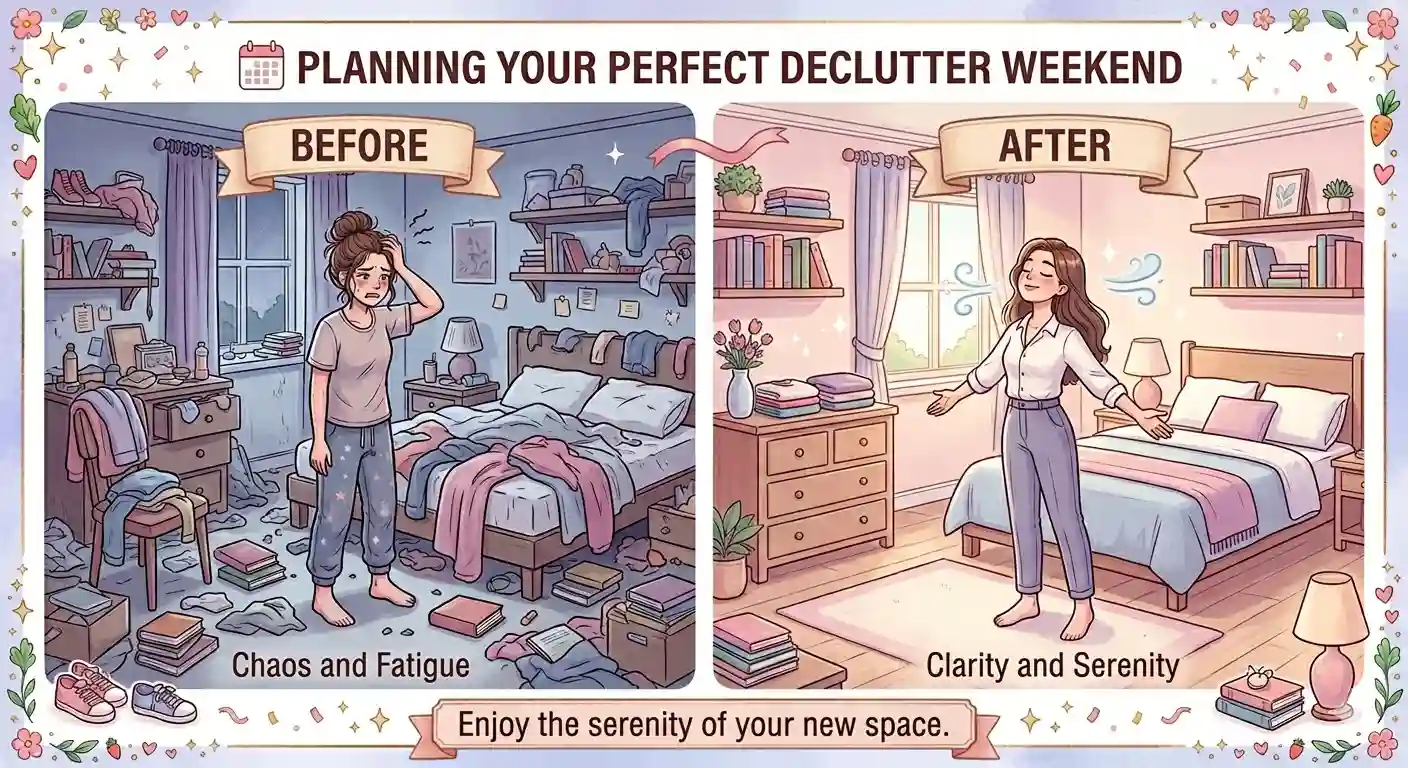
Saturday is for clearing and sorting. Sunday is for organizing and resetting.
Don’t try to do both in one day. I made that mistake the first time. By hour four, I was exhausted, everything was in a pile on the floor, and I felt worse than when I started.
Here’s the structure that works:
- Saturday morning: Clear every surface in the room bed, nightstand, dresser top, floor, chair, windowsill. Everything goes somewhere temporary (the hallway works well).
- Saturday afternoon: Sort through it all using the 4-pile system. Make fast decisions.
- Saturday evening: Donate box goes in your car immediately. Trash goes in the bin. Done for the day.
- Sunday morning: Deal with the clothes and the closet.
- Sunday afternoon: Put everything back only what belongs, only with a designated spot.
- Sunday evening: Final sweep. Enjoy your room.
💡 Personal tip: I put on a podcast or a playlist before starting. The moment there’s background noise, the task feels 40% less heavy. Silence makes you overthink.
🗂️ Saturday: The 4-Pile System That Actually Works
Pull everything out. Yes, everything. Every item from every surface, drawer, shelf, and floor. Put it all in your hallway or on your bed temporarily.
Now sort into exactly four piles nothing more, nothing less:
✅ Pile 1: Keep (It belongs in this room)
Only items that genuinely belong in a bedroom: sleep-related, getting-dressed-related, or items you use daily while in this room. If you’re not sure, it doesn’t go here.
📦 Pile 2: Relocate (It belongs somewhere else in the house)
Half-empty glasses, phone chargers that belong at a desk, the random screwdriver, the stack of mail. These items have a home it’s just not your bedroom. Box them up and take them there on Sunday.
🎁 Pile 3: Donate (Someone else could use this)
Be ruthless here. If you haven’t used it in 12 months, if it doesn’t fit, if you kept it out of guilt it goes here. One rule I follow: if I wouldn’t buy it again today, it leaves.
🗑️ Pile 4: Trash (Broken, expired, or beyond saving)
Broken things you’ve meant to fix for over a year. Old receipts. Packaging you’ve kept “just in case.” Dead pens. Let them go.
💡 Personal rule I swear by: The moment I finish sorting, the donate box goes directly into my car. Not near the door. Not in the hallway. In the car. That way, I can’t talk myself into keeping anything overnight.
👕 Sunday Morning: Tackling the Clothes (The Hardest Part)
I’m dedicating a full section to clothes because they are without exception the hardest part of any bedroom declutter. They carry the most emotion, the most guilt, and the most “but what if I need this someday” thinking.
Here’s the approach I use, and it’s the only one that’s ever worked for me:
Pull every item of clothing out of the closet and drawers. Everything. Pile it on the bed.
Now go through each piece and ask yourself one question only: “Do I feel good when I wear this?” Not “is it still wearable?” Not “was it expensive?” Just: does wearing this make me feel like myself?
If yes keep it. If you hesitate for more than three seconds donate pile.
A few honest rules I’ve added over time:
- Anything that only fits “if I lose weight” donate it. It’s not motivating you, it’s guilting you.
- Anything you’ve kept because it was a gift but you never actually wear donate it. The person who gave it to you wanted you to feel good, not to store a weight on your shoulders.
- Anything with a stain, a broken zip, or a stretched-out neckline trash pile. You’re not going to fix it.
For the clothes that stay, I organize them back by frequency of use, not by category or color. What I wear most often lives at the front and at eye level. What I wear occasionally lives further back. What’s seasonal gets stored separately.
📖 If your closet needs a full system overhaul beyond just decluttering, I wrote a complete guide on how to organize a closet when you have too many clothes it covers zoning, rod doublers, and the vacuum-seal method for off-season pieces.
🗺️ Sunday Afternoon: Putting It All Back (With a System)
This is where most people rush and then wonder why their room reverts to chaos within two weeks. The “put back” phase is not just tidying. It’s designing your room’s logic.
Every item that goes back into your bedroom needs to answer one question: where does this live? Not “where can I put this for now.” Where does it permanently belong.
Here’s how I think about the room in zones:
┌──────────────────────────────────────────┐
│  TOP SHELF / HIGH STORAGE                │
│  🗄️ Seasonal & rarely used items         │
├──────────────────────────────────────────┤
│  CLOSET / DRAWERS / MID STORAGE          │
│  👕 Clothes, organized by frequency      │
├──────────────────────────────────────────┤
│  NIGHTSTAND / BED ZONE                   │
│  🌙 Sleep essentials only — book, lamp,  │
│  phone, water glass. Nothing else.       │
├──────────────────────────────────────────┤
│  FLOOR / UNDER BED                       │
│  📦 Intentional storage only — or empty  │
└──────────────────────────────────────────┘
The nightstand is the zone most people underestimate. I used to have 11 things on mine. Now I have 4: a lamp, a glass of water, my current book, and my phone. That’s it. The visual calm it creates is immediate and dramatic.
📖 If you have a small bedroom and storage is genuinely limited, our guide on small bedroom storage ideas for a clutter-free space covers the Zone Method and vertical storage hacks that pair perfectly with this declutter process.
The under-bed space deserves its own consideration. If it’s currently a chaos zone of forgotten objects, now is the time to either use it intentionally with proper containers for seasonal items or leave it empty. Empty under the bed is infinitely better than random under the bed.
⚠️ 4 Mistakes That Undo a Bedroom Declutter (I Made All of Them)
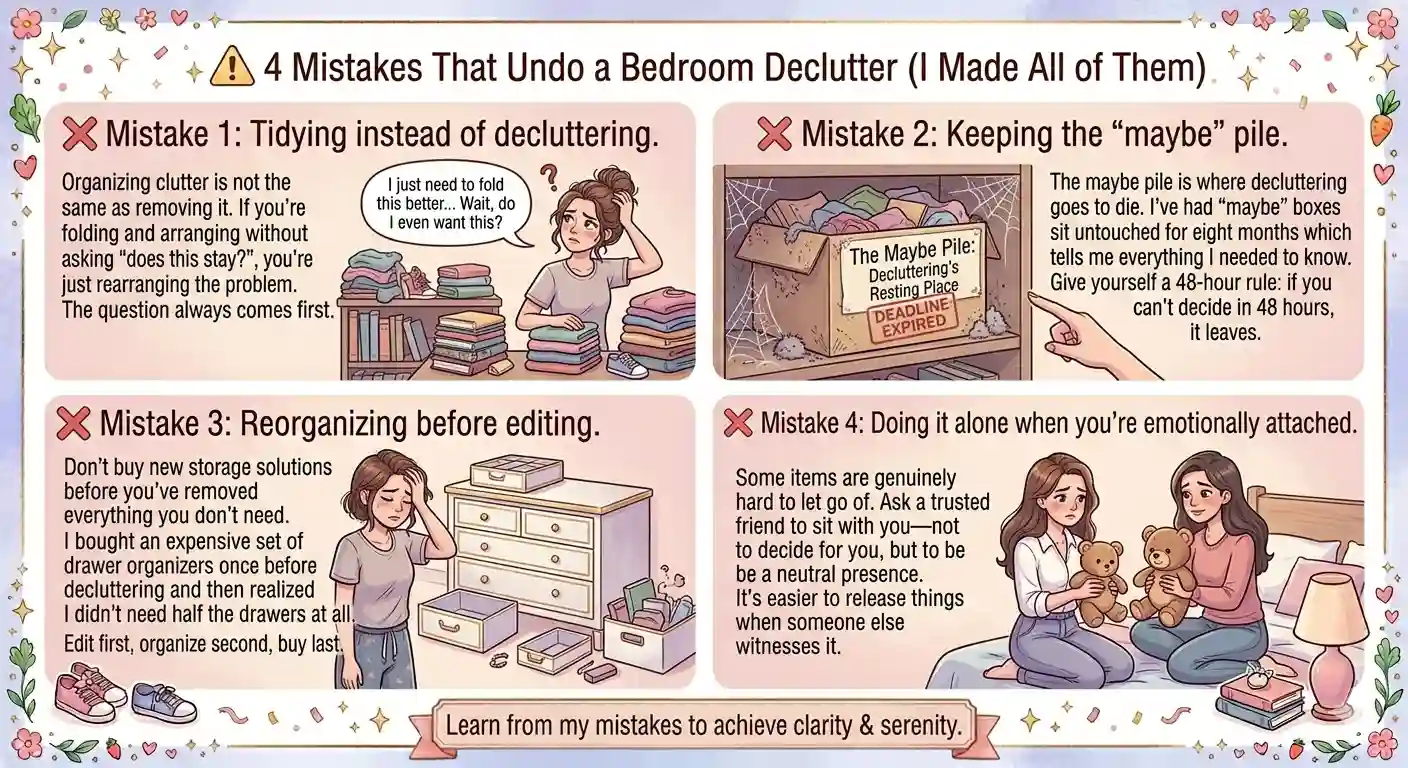
❌ Mistake 1: Tidying instead of decluttering
Organizing clutter is not the same as removing it. If you’re folding and arranging without asking “does this stay?”, you’re just rearranging the problem. The question always comes first.
❌ Mistake 2: Keeping the “maybe” pile
The maybe pile is where decluttering goes to die. I’ve had “maybe” boxes sit untouched for eight months which tells me everything I needed to know. Give yourself a 48-hour rule: if you can’t decide in 48 hours, it leaves.
❌ Mistake 3: Reorganizing before editing
Don’t buy new storage solutions before you’ve removed everything you don’t need. I bought an expensive set of drawer organizers once before decluttering and then realized I didn’t need half the drawers at all. Edit first, organize second, buy last.
❌ Mistake 4: Doing it alone when you’re emotionally attached
Some items are genuinely hard to let go of. Ask a trusted friend to sit with you not to decide for you, but to be a neutral presence. It’s easier to release things when someone else witnesses it.
🔄 How to Keep Your Bedroom Decluttered Long-Term
A decluttered bedroom only stays that way if you build a few small habits around it. None of these take more than five minutes.
- The Sunday reset: Every Sunday evening, spend 5 minutes returning anything that’s drifted out of place. Catch the drift before it becomes a pile.
- One-in, one-out: Every time something new comes into the bedroom a new book, a new piece of clothing, a new anything one old item leaves. Non-negotiable.
- The “homeless object” rule: If something is sitting somewhere because it has no designated home, that’s a signal either find it a home or remove it from the room entirely. Objects without homes become clutter within days.
- The 30-second rule: If putting something away takes less than 30 seconds, do it now. Don’t set it down “for a moment.” Those moments accumulate into the chaos you just spent a weekend clearing.
🎯 Final Thoughts
A decluttered bedroom isn’t a Pinterest aesthetic. It’s a feeling.
It’s the difference between walking into your room and exhaling versus walking in and feeling that low, constant hum of unfinished business. That hum is real. And it costs you sleep, mental energy, and peace every single day.
You don’t need a bigger bedroom. You don’t need better furniture. You need less. Less visual noise, fewer objects making silent demands on your attention, more intentional use of the space you already have.
Start Saturday morning. Give yourself the weekend. Trust the process.
And if you want to keep building from here, here are the guides that pair best with this one:
- 👉 How to Organize a Closet When You Have Too Many Clothes
- 👉 Small Bedroom Storage Ideas for a Clutter-Free Space
- 👉 How to Organize a Refrigerator to Reduce Food Waste
What room are you tackling after the bedroom? Drop it in the comments I read every one.
❓ FAQ — People Also Ask
🕐 How long does it actually take to declutter a bedroom?
With focused effort and the two-day system in this guide, most bedrooms are fully decluttered and reorganized in one weekend roughly 8 to 12 hours total across Saturday and Sunday. Larger rooms or more severe accumulation may take slightly longer, but the method stays the same.
🧹 Where do I start when decluttering a bedroom?
Start with the surfaces, not the drawers. Clear the floor, the nightstand, the dresser top, and the bed first. Visible clutter is the most psychologically heavy clearing it gives you immediate momentum and a cleaner space to work from.
💭 How do I decide what to keep when decluttering?
Use one question: “Do I feel good when I use or wear this?” Skip the practical justifications. If you hesitate more than three seconds, that hesitation is your answer. Anything you haven’t touched in 12 months should be donated unless it’s genuinely seasonal.
🔁 How do I stop my bedroom from getting cluttered again?
Three habits matter most: the Sunday 5-minute reset, the one-in one-out rule for anything new entering the room, and giving every object a permanent home before it earns a place in the bedroom. Objects without homes become clutter within days.