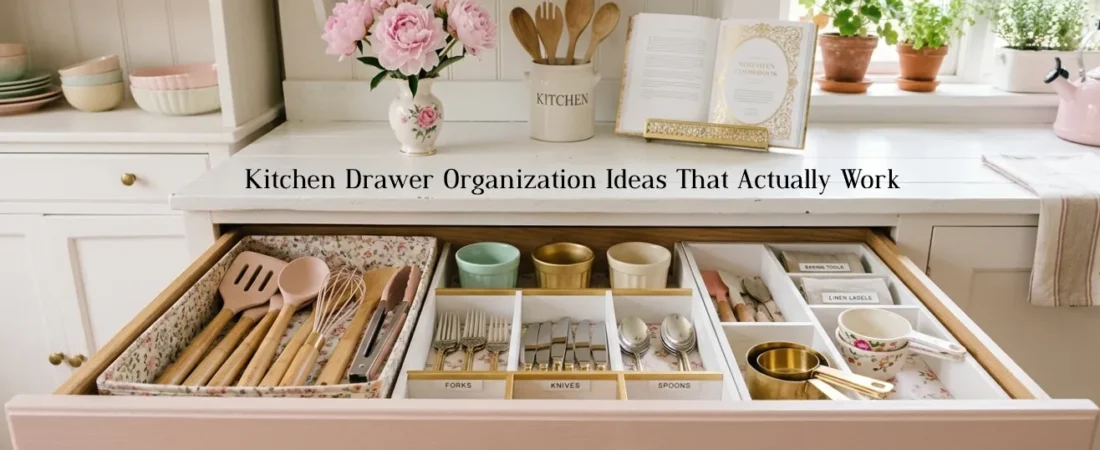
If your kitchen drawers are a chaotic jumble of spatulas, mystery lids, and rubber bands from 2019, you’re in good company. Kitchen drawer organization ideas are some of the most searched home topics on Google and for good reason. Studies show the average person wastes 2.5 days per year searching for misplaced items at home, and a huge chunk of that time happens in the kitchen. In this guide, you’ll get a complete, step-by-step system to organize every drawer in your kitchen even the dreaded junk drawer with practical tips, real product picks, and habits that actually stick.
😩 Why Kitchen Drawer Organization Is Harder Than It Looks (And How to Fix It)
You reorganize the drawer. It looks great for three days. Then somehow without any conscious decision it becomes a disaster again.
You’re not failing at organization. The system is failing you.
Here’s what’s actually going on:
- No defined zones. When everything “goes in the drawer,” nothing has a real home, and clutter fills every gap
- Wrong-sized organizers. Most people buy dividers that don’t fit their drawers properly, leaving dead space where chaos lives
- Too much stuff. The average kitchen drawer holds 40% more items than it should, according to a National Association of Productivity & Organizing Professionals survey
I used to have four drawers that I mentally labeled “miscellaneous.” Opening any of them felt like a gamble. The fix wasn’t buying more storage it was being ruthless about what earned drawer space in the first place.
Pro tip: Before buying a single organizer, audit what’s actually in your drawers. You’ll likely discover 30% of the contents belong somewhere else entirely.
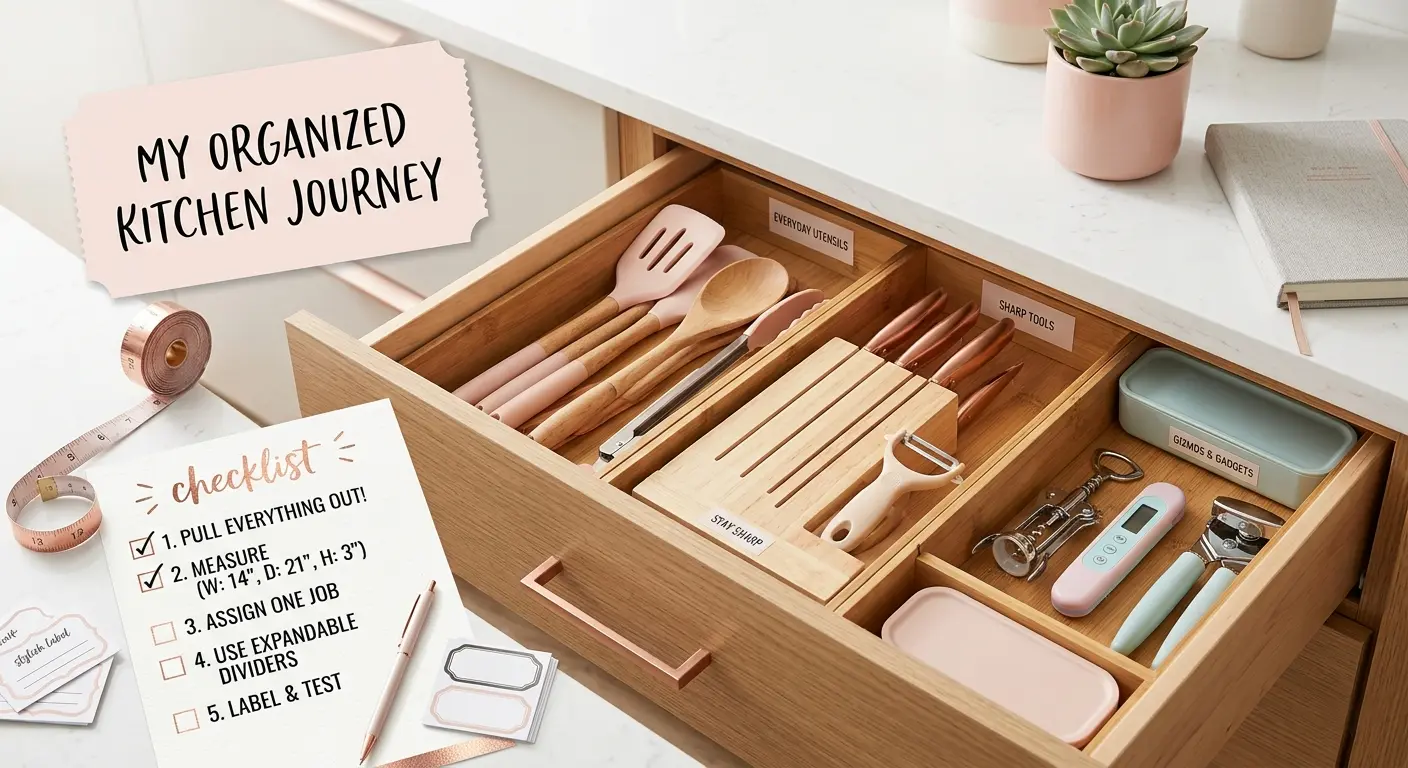
🔪 Step-by-Step: Kitchen Drawer Organization Ideas That Actually Work
🗑️ Step 1: Pull Everything Out and Start From Zero
Don’t organize around what’s already there. Empty every drawer completely onto the counter or kitchen table.
This step feels dramatic and it should. Seeing everything at once is the only way to make honest decisions.
- Toss: expired coupons, broken tools, duplicates you forgot you had
- Relocate: anything that doesn’t belong in the kitchen (batteries, chargers, old mail)
- Question: anything you haven’t touched in 6 months
Concrete example: I pulled out my utensil drawer last year and found three vegetable peelers. Three. I kept one, donated one, and tossed the rusted one. Instant space.
🔍 Honest caveat: This step takes longer than you think budget 45 minutes for a full kitchen, not 10. Put on a podcast and commit.
📏 Step 2: Measure Before You Buy Anything
This is the step that saves you from returning three sets of organizers.
Measure the interior width, depth, and height of each drawer not the outside. Write it down on your phone. Take a photo.
- Most standard kitchen drawers are 20–24 inches deep and 12–15 inches wide
- Shallow drawers (under 2.5 inches tall) need flat, low-profile organizers
- Deep drawers work great with stackable bins or dividers with adjustable height
I skipped this step once and bought a beautiful bamboo organizer set that was 1.5 inches too wide. It sat in my closet for eight months before I donated it. Ten minutes of measuring would have saved me $28.
Pro tip: Write measurements on a sticky note and keep it in your wallet until you’ve finished buying organizers.
🧰 Step 3: Assign One Job to Each Drawer
The biggest mistake in kitchen drawer organization? Letting drawers become multi-purpose catch-alls.
Give each drawer a single category:
- Drawer 1: Everyday utensils (spatulas, ladles, tongs, wooden spoons)
- Drawer 2: Sharp tools (knives, peelers, graters use a knife insert or blade guard)
- Drawer 3: Small gadgets (can opener, corkscrew, thermometer)
- Drawer 4: Wraps & bags (plastic wrap, foil, ziplock bags, parchment paper)
- Drawer 5 (if you have it): The intentional junk drawer yes, this is allowed, but with rules (more on that below)
Concrete example: Moving my wraps and bags out of my utensil drawer freed up so much space that I no longer need to fight to close it. That alone was a 5-minute win with a massive payoff.
🗂️ Step 4: Use Expandable Drawer Dividers, Not Bins
Here’s a kitchen drawer organization idea most people overlook: adjustable expandable dividers beat rigid bins almost every time.
Why? Because bins leave awkward gaps. Expandable dividers stretch to fill your exact drawer width, creating snug sections that don’t shift around.
How to use them:
- Install 2–3 dividers per drawer to create 3–4 zones
- Place most-used items at the front, least-used at the back
- Group by task: “flipping things,” “stirring things,” “cutting-adjacent things”
A 2022 consumer organizing study found that people who used adjustable drawer systems reported 60% fewer “can’t find it” moments in the kitchen compared to those using static bins. Small tweak, real results.
Pro tip: For the knife drawer specifically, use a bamboo in-drawer knife block. It keeps blades safe and avoids the terrifying experience of reaching in and finding the sharp end first.
🏷️ Step 5: Add Labels and Do a 30-Day Test Run
Labels feel fussy until you live with them for a week. Then they feel essential.
You don’t need a label maker. Masking tape and a marker works perfectly well and you can change them easily during your 30-day test run.
- Label each zone or section inside the drawer
- After 30 days, notice where items consistently end up in the wrong place
- Adjust zones based on real behavior, not ideal behavior
Concrete example: I originally put my silicone spatulas in the “flipping” zone, but I kept reaching for them when stirring too. I merged the zones. Real life beats theory every time.
🔍 Research backs this up: habit researchers at MIT found that environmental cues (like clear labels and dedicated spots) reduce decision fatigue and make new habits 40% more likely to stick long-term.
🛒 Best Products for Kitchen Drawer Organization (All Under $30)
Here are six picks that consistently get the job done without breaking your budget:
| Product | Why It Works | Approx. Price |
|---|---|---|
| Joseph Joseph DrawerStore Organizer | Holds knives, spatulas, and spoons in one tray | ~$25 |
| Bamboo Expandable Drawer Dividers (set of 4) | Adjusts to exact drawer width, no gaps | ~$18 |
| OXO Good Grips Drawer Organizer | Deep sections, non-slip base, dishwasher safe | ~$22 |
| Madesmart 6-Piece Interlocking Bins | Modular reconfigure any time | ~$16 |
| SimpleHouseware In-Drawer Knife Block | Keeps blades safe and accessible | ~$20 |
| Bino Stackable Drawer Organizer Bins | Great for the junk drawer or gadget drawer | ~$14 |
Pro tip: Clear or white organizers photograph well if you ever post your kitchen on Pinterest or Instagram and they make it easy to spot when something’s out of place.
❌ Common Mistakes to Avoid
- Buying organizers before emptying the drawer. You end up organizing clutter instead of fixing the root problem fix: always purge first, then measure, then buy.
- Trying to fit everything back in. If it all fit before, it was already too full fix: be willing to relocate or donate at least 20% of what came out.
- Using one giant tray for the whole drawer. A single organizer tray wastes vertical space and limits flexibility fix: use multiple smaller dividers you can rearrange.
- Skipping the junk drawer. Pretending it doesn’t exist means it expands fix: give it a defined boundary (one drawer, one category max: batteries, rubber bands, pens) and edit it monthly.
📅 How to Keep Your Kitchen Drawers Organized Long-Term
The system works. But it only stays working if you do these four things consistently:
- The 60-second reset: Once a day (I do it after dinner), spend 60 seconds putting anything out of place back where it belongs. That’s it. One minute.
- Monthly drawer check: On the first of each month, open each drawer and pull out anything that crept in from another category. Rehome it immediately.
- One-in, one-out rule: When a new tool or gadget comes into the kitchen, something old leaves. No exceptions otherwise drawers fill back up within weeks.
- Quarterly deep edit: Every three months, pull everything out again and ask: “Did I use this?” If not, it doesn’t earn its spot back.
Personal note: I put a recurring reminder in my phone for the first of the month that just says “drawer check.” Takes four minutes. It’s the reason my kitchen drawers still look decent eight months after I reorganized them.
🔍 According to a study by the Princeton Neuroscience Institute, physical clutter competes for your attention and increases cortisol (stress hormone) levels even when you’re not consciously looking at it. Organized drawers aren’t just pretty. They actually reduce low-grade daily stress.
🎉 Final Thoughts + Call to Action
Here’s what to take away from all of this:
- The purge always comes first organized clutter is still clutter, and no product fixes an overcrowded drawer
- Measure before you buy the right organizer for your exact drawer is worth ten times more than a beautiful one that doesn’t fit
- Assign one job per drawer the moment a drawer becomes “miscellaneous,” it starts filling up with everything you don’t know where to put
Start with just one drawer today. The utensil drawer is usually the easiest win. Empty it, measure it, decide what actually belongs there, and put back only what earns its place.
Once your drawers are sorted, the next logical step is tackling what’s above them. Ready to go further? Check out our guide on How to Organize Under the Kitchen Sink (Step-by-Step) it uses the exact same approach applied to one of the trickiest spots in the kitchen.
One question for you: What’s the one drawer in your kitchen that makes you cringe every time you open it?